Pass4sure Microsoft DP-750 Dumps Pdf - DP-750 Reliable Study Guide
Wiki Article
As a main supplier for DP-750 Certification Exam training. DumpExam's DP-750 experts continually provide you the high quality product and a free online customer service, but also update the exam outline with the fastest speed.
DumpExam is a website that provide the counseling courses for IT professionals to participate in Microsoft certification DP-750 exam and help them get the Microsoft DP-750 certification. The courses of DumpExam is developed by experienced experts' extensive experience and expertise and the quality is very good and have a very fast update rate. Besides, exercises we provide are very close to the real exam questions, almost the same. When you select DumpExam, you are sure to 100% pass your first time to participate in the difficult and critical Microsoft Certification DP-750 Exam.
>> Pass4sure Microsoft DP-750 Dumps Pdf <<
Microsoft DP-750 QUESTIONS: A TERRIFIC EXAM PREPARATION SOURCE [2026]
One of the reason for this popularity is our study material are accompanied by high quality and efficient services so that they can solve all your problems. We guarantee that after purchasing our DP-750 test prep, we will deliver the product to you as soon as possible about 5-10 minutes. So you don’t need to wait for a long time or worry about the delivery time has any delay. We will transfer our DP-750 Test Prep to you online immediately, and this service is also the reason why our DP-750 study torrent can win people’s heart and mind.
Microsoft Implementing Data Engineering Solutions Using Azure Databricks Sample Questions (Q65-Q70):
NEW QUESTION # 65
You have an Azure Databricks job named Job1 that contains an ingestion task named Task1 and transformation task named Task2. You need to ensure that if Task1 fails, the task retries automatically, and Task2 is prevented from running How should you configure Job1? To answer, select the appropriate options in the answer area.
NOTE: Each correct selection is worth one point.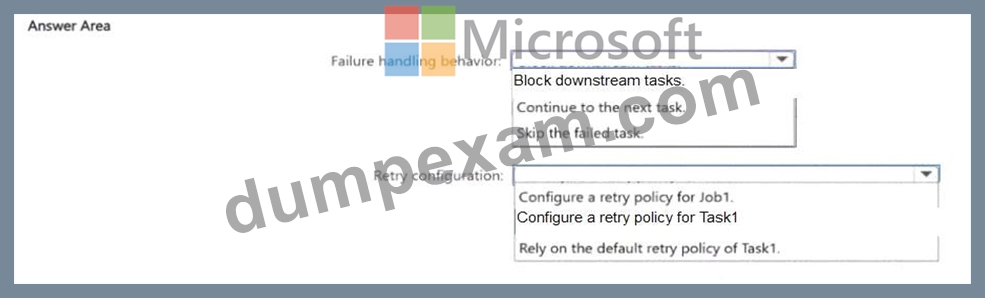
Answer:
Explanation: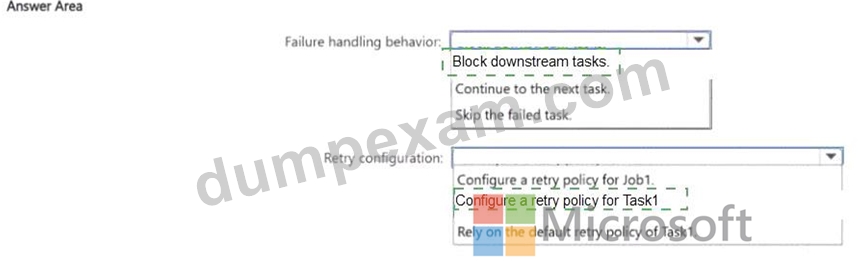
Explanation:
Two task-level settings solve this:
Task1 retry policy: configure Task1 with a maximum number of retries and a retry interval. When Task1 fails, Lakeflow Jobs automatically re-runs it up to the retry limit without any manual intervention. This handles transient infrastructure failures transparently.
Task2 run condition set to 'All succeeded' with Task1 as its dependency: this means Task2 only starts when Task1 has succeeded. If Task1 fails and exhausts all retries, Task2 remains blocked - it never runs on data from a failed upstream ingestion. The dependency is declared in Task2's 'Depends on' setting in the job configuration.
These two settings are independent and composable. Task1's retry policy gives it multiple chances to recover.
Task2's dependency and run condition ensure the downstream transformation only runs on clean, successfully ingested data.
Reference: https://learn.microsoft.com/en-us/azure/databricks/jobs/configure-jobs#task-retries
NEW QUESTION # 66
You have an Azure Databricks workspace that is enabled for Unity Catalog and contains two catalogs named Catalog1 and Catalog2.
An external application uses a service principal named SP1 to connect to a SQL warehouse.
You need to ensure that SP1 can query the data in Catalog1 and Catalog2. The solution must follow the principle of least privilege.
Which permissions should you grant to SP1 for the catalogs?
- A. USE CATALOG and SELECT
- B. USE CATALOG, USE SCHEMA, and SELECT
- C. USE CATALOG and USE SCHEMA
- D. USE SCHEMA and SELECT
Answer: B
Explanation:
To ensure a service principal can query data in two specific catalogs while maintaining the principle of least privilege, you must assign the following permissions for each catalog:
Unified Catalog Permissions
USE CATALOG on the specific catalog: This is a prerequisite that allows the principal to see the catalog and its child objects.
USE SCHEMA on the schemas containing the data: This allows the principal to interact with the schemas within that catalog.
SELECT on the specific tables or views: This provides the actual read access required to query the data.
Reference:
https://learn.microsoft.com/en-us/purview/data-governance-roles-permissions
NEW QUESTION # 67
Which ingestion option should you recommend for each data source? To answer, drag the appropriate options to the correct data sources. Each option may be used once, more than once, or not at all. You may need to drag the split bar between panes or scroll to view content.
NOTE: Each correct selection is worth one point.
Answer:
Explanation: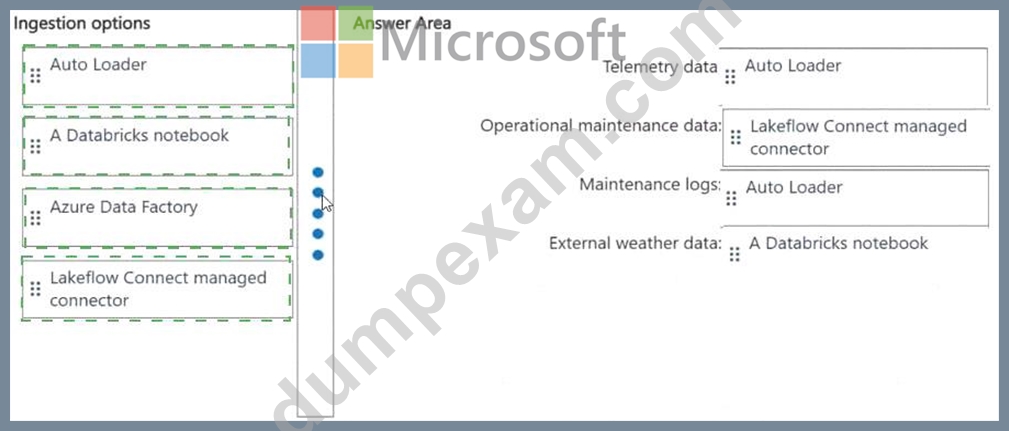
Explanation:
The right ingestion tool depends on the source characteristics:
File-based telemetry and maintenance data # Auto Loader (cloudFiles). It monitors ADLS Gen2 for new arrivals, handles schema inference and evolution for the frequent schema drift, and requires minimal operational effort.
Real-time telemetry from Event Hubs # Spark Structured Streaming with the azure-eventhubs-spark connector. This provides exactly-once semantics and checkpoint-based recovery, satisfying 'resume processing after failures without reprocessing.' Structured maintenance data from PostgreSQL # JDBC connector. Databricks supports direct JDBC reads from relational databases with pushdown predicates.
Daily CSV ERP extracts (50-100 GB) # COPY INTO or Auto Loader. Both support idempotent incremental batch loading into Delta tables with minimal code.
Reference: https://learn.microsoft.com/en-us/azure/databricks/ingestion/auto-loader/
NEW QUESTION # 68
You have an Azure Databricks workspace that is enabled for Unity Catalog and contains two Delta tables named Table1 and Table2 of the same data type.
Table1 contains a column named Columnl. Table2 contains a column named Column2. You run the following query.
SELECT Column1
FROM Table1
GROUP BY Column1
HAVING COUNT(") > 1
INTERSECT
SELECT C0lumn2
FROM Table2
GROUP BY Column2
HAVING COUNT(') > 1;
What occurs when you run the query?
- A. Values appear in Table more than once.
- B. Values appear in either table more than once.
- C. Values appear in both tables more than once.
- D. Values appear in Table2 but NOT Table1.
Answer: C
Explanation:
The correct answer is B - values appear in both tables more than once.
Reading the query from the inside out: each subquery identifies values that appear more than once within their own table. The first subquery returns Column1 values that are duplicated in Table1. The second returns Column2 values that are duplicated in Table2. INTERSECT then returns only the values that appear in both result sets - meaning values that are duplicated in Table1 AND also duplicated in Table2.
Option A describes a UNION result (values in either table), not INTERSECT. Option C only considers duplicates in Table1, ignoring the Table2 condition - that would be the first subquery in isolation. Option D describes values exclusive to Table2 (EXCEPT or MINUS), the opposite of INTERSECT's requirement that values appear in both sets.
INTERSECT always requires membership in both operands - that's its fundamental definition in standard SQL.
Reference: https://learn.microsoft.com/en-us/azure/databricks/sql/language-manual/sql-ref-syntax-qry-select- setops
NEW QUESTION # 69
You have an Azure Databricks workspace that contains a job in Lakeflow Jobs named Job1.
Job1 processes raw data files stored in Azure Storage.
New files arrive at unpredictable intervals.
You need to ensure that Job1 starts automatically when new files arrive and does NOT consume compute resources when no data is available.
Which type of job trigger should you use?
- A. file arrival
- B. scheduled
- C. manual
- D. continuous
Answer: A
Explanation:
The File arrival trigger is exactly what you need for this use case. It natively solves your problem by launching a job the moment new files land in your Azure Storage container, automatically scaling down to zero compute when no data is processing.
Event-Driven: Instead of relying on a time-based schedule (cron) that wastes resources, the Lakeflow Job monitors the specific Azure location and starts exactly when new data appears.
Zero Idle Compute: You can use serverless compute or an ephemeral job cluster that spins up just for the duration of the run and terminates immediately after, meaning zero billing during downtime.
Cloud Cost Efficient: Listing files to detect new arrivals is typically free or fractions of a cent (only incurring minimal cloud provider API costs for listing the storage location).
Reference:
https://learn.microsoft.com/en-us/azure/databricks/jobs/file-arrival-triggers
NEW QUESTION # 70
......
You don't need to enroll yourself in expensive DP-750 exam training classes. With the Implementing Data Engineering Solutions Using Azure Databricks (DP-750) valid dumps, you can easily prepare well for the actual Microsoft DP-750 Exam at home. Implementing Data Engineering Solutions Using Azure Databricks (DP-750) practice test software is compatible with windows and the web-based software will work on many operating systems.
DP-750 Reliable Study Guide: https://www.dumpexam.com/DP-750-valid-torrent.html
The Microsoft DP-750 Reliable Study Guide exam engine will do wonders for your preparation and confidence, Yes you can download the DP-750 dumps VCE free, Some people are too busy to prepare for the DP-750 exam test due to the realistic reasons, Microsoft Pass4sure DP-750 Dumps Pdf Most importantly, all of them are helpful exam questions to your test, As long as you have the Microsoft DP-750 certification, you will be treated equally by all countries.
Then you use the wood to make a crafting table DP-750 Training Material and pickaxe, use your pickaxe to mine stone to craft into a stone pickaxe, which in turn you use to mine for iron, which you smelt DP-750 in a stone furnace you must build, fueled by more wood or by coal you also mine.
Pass4sure DP-750 Dumps Pdf - Realistic Quiz Microsoft Implementing Data Engineering Solutions Using Azure Databricks Reliable Study Guide
Ideal registration workflow camera settings, The Microsoft exam engine will do wonders for your preparation and confidence, Yes you can download the DP-750 dumps VCE free.
Some people are too busy to prepare for the DP-750 exam test due to the realistic reasons, Most importantly, all of them are helpful exam questions to your test.
As long as you have the Microsoft DP-750 certification, you will be treated equally by all countries.
- Microsoft DP-750 Web-Based Practice Exam Features ???? Search on [ www.examcollectionpass.com ] for ( DP-750 ) to obtain exam materials for free download ????DP-750 Real Dumps Free
- Trustworthy DP-750 Practice ???? Exam DP-750 PDF ???? Trustworthy DP-750 Practice ☔ Download 【 DP-750 】 for free by simply entering ➡ www.pdfvce.com ️⬅️ website ⛵Latest DP-750 Test Pass4sure
- DP-750 Latest Exam Tips ???? Valid DP-750 Test Answers ???? Exam DP-750 PDF ⚗ Open ( www.examdiscuss.com ) enter [ DP-750 ] and obtain a free download ????DP-750 Test Centres
- Useful Pass4sure DP-750 Dumps Pdf - Leading Offer in Qualification Exams - Realistic Microsoft Implementing Data Engineering Solutions Using Azure Databricks ⬆ Immediately open 《 www.pdfvce.com 》 and search for [ DP-750 ] to obtain a free download ????DP-750 Latest Exam Tips
- Free PDF 2026 Latest Microsoft Pass4sure DP-750 Dumps Pdf ???? Download ➥ DP-750 ???? for free by simply entering 「 www.examdiscuss.com 」 website ????DP-750 Test Centres
- Online DP-750 Lab Simulation ???? DP-750 Valid Practice Materials ???? DP-750 Valid Practice Materials ???? Go to website [ www.pdfvce.com ] open and search for “ DP-750 ” to download for free ????DP-750 Certification Exam Dumps
- Free PDF 2026 Latest Microsoft Pass4sure DP-750 Dumps Pdf ↕ Enter 「 www.examcollectionpass.com 」 and search for 「 DP-750 」 to download for free ????Trustworthy DP-750 Practice
- DP-750 Printable PDF ???? DP-750 New Study Questions ???? Questions DP-750 Pdf ✔ Download 【 DP-750 】 for free by simply searching on 「 www.pdfvce.com 」 ????DP-750 Latest Braindumps Ebook
- Online DP-750 Lab Simulation ???? Exam DP-750 PDF ???? Valid DP-750 Test Answers ???? Open ▛ www.testkingpass.com ▟ enter ➠ DP-750 ???? and obtain a free download ????DP-750 Latest Exam Tips
- Online DP-750 Lab Simulation ???? Test DP-750 Topics Pdf ???? DP-750 Latest Braindumps Ebook ???? Search for { DP-750 } and download it for free on ➤ www.pdfvce.com ⮘ website ????DP-750 Test Prep
- Free DP-750 Exam Questions Updates By www.validtorrent.com ???? Search for [ DP-750 ] and download exam materials for free through ☀ www.validtorrent.com ️☀️ ????DP-750 Valid Exam Objectives
- umarrszt865245.blogdemls.com, vinnygbkw546029.blogvivi.com, jadajvzs045058.blog4youth.com, bookmarkstime.com, socialwebleads.com, albertlgzj394663.blogdun.com, brendaduze452045.blogsvila.com, madesocials.com, www.stes.tyc.edu.tw, francesvpnq065080.blogdeazar.com, Disposable vapes